
Taj Mahal at Sunrise: Tickets, Timings and Tips From a Local Guide
The best time to see the Taj Mahal is at sunrise. The monument opens 30 minutes before sunrise and closes 30 minutes before sunset, every day except Friday, when it is closed to visitors. For foreign tourists, the official Agra district website lists the entry fee at ₹1,100, plus ₹200 if you want to enter the main mausoleum, and children under 15 enter free. Buy your ticket online the day before, arrive at the east or west gate before opening time, and you’ll see the Taj at its quietest and most beautiful.
I’m Ashish, a licensed tour guide based in Delhi, and the Taj Mahal is a place I never tire of. This guide covers everything you need to plan a sunrise visit: tickets, gates, timings, what to bring, what to expect inside, and how to fit Agra into your wider trip.
Why sunrise is the best time to visit
The Taj Mahal is beautiful at any hour, but sunrise gives you something special. As the sky lightens, the white marble changes colour, from grey to a soft pink and then to bright white as the sun rises. The light is gentle, the gardens are calm, and in winter a light mist often hangs over the Yamuna river behind the monument.
Sunrise also means fewer people. By mid-morning, especially on weekends and holidays, the Taj Mahal can be extremely crowded, with long queues at security and crowds at every viewpoint. Arriving at opening time lets you see the monument and take photographs before the busiest period.
There’s a practical reason too. For much of the year, Agra is hot by late morning, and walking across the open marble platform at midday can be uncomfortable. Early mornings are cooler and far more pleasant, especially from March onwards.
The only real drawback is the early start. Depending on the season, you may need to leave your hotel before 6 a.m. Most visitors agree it’s well worth it.
A little history
The Taj Mahal was built by the Mughal emperor Shah Jahan as a tomb for his wife, Mumtaz Mahal, who died in 1631 while giving birth to their fourteenth child. Construction began soon afterwards and continued for around two decades, involving thousands of artisans and craftsmen from across the empire and beyond. The complex includes the white marble mausoleum, a mosque, a guest house, formal gardens and an impressive main gateway.
Shah Jahan was later deposed by his son Aurangzeb and spent his final years confined in Agra Fort, from where he could see the Taj Mahal across the river. When he died, he was buried in the Taj beside his wife. The monument was declared a UNESCO World Heritage Site in 1983 and is widely regarded as one of the finest examples of Mughal architecture.
Knowing a little of this story adds a great deal to a visit, because the Taj is not just a beautiful building but a monument to love, loss and imperial power. A guide can explain the symbolism of the gardens, the remarkable inlay work, the calligraphy, and the optical tricks the architects used to make the building appear perfectly proportioned from every angle.
Opening hours
The Taj Mahal opens 30 minutes before sunrise and closes 30 minutes before sunset. Sunrise times vary through the year, from around 5:30 a.m. in early summer to around 7 a.m. in midwinter, so check the sunrise time for your date and plan to arrive at the gate a little before opening.
The Taj Mahal is closed to visitors every Friday. The mosque within the complex is open for Friday prayers only. If your Agra day falls on a Friday, rearrange your plans.
Tickets and prices
Ticket prices are set by the Archaeological Survey of India and the local authorities, and they can change, so always check the official website before you go. At the time of writing, the official Agra district website lists the following for foreign visitors:
- Entry to the Taj Mahal complex: ₹1,100.
- Additional fee to enter the main mausoleum: ₹200.
- Children under 15: free.
Indian citizens and visitors from some neighbouring countries pay considerably less. The foreign visitor ticket usually includes shoe covers and a small bottle of water.
Buying tickets online
I strongly recommend buying your ticket online, ideally the day before. It saves queuing at the ticket counter in the early morning, and online tickets are often slightly cheaper. Use the official ticketing portal of the Archaeological Survey of India, which is linked from the official government websites. Avoid unofficial resellers and anyone who approaches you outside offering tickets.
Is the mausoleum ticket worth it?
Yes. The extra ₹200 lets you enter the main tomb chamber, where you can see the cenotaphs of Shah Jahan and Mumtaz Mahal and the extraordinary pietra dura inlay work up close. Photography is not permitted inside the tomb chamber itself.
Which gate to use
The Taj Mahal has three gates: east, west and south. Visitors enter through the east or west gate. The south gate is generally used as an exit.
The east gate is often slightly quieter at sunrise and is close to many of Agra’s larger hotels. The west gate is near the main road from Agra city and the parking area, and can be busier later in the day. Both have ticket counters and cloakrooms. Electric vehicles or battery-powered carts usually run from the parking areas to the gates, as fuel-powered vehicles aren’t allowed close to the monument.
Security and what you can bring
Security at the Taj Mahal is thorough, and you should allow time for it, especially at busy times.
You can bring a phone, a camera, a small bag, a bottle of water and your passport or identification. Items not allowed inside include large bags, food, tripods, drones, knives, lighters, and some electronic items. Rules can change, so check before you go. Lockers and cloakrooms are available near the gates if you need to leave something behind.
To keep things simple, travel light on the day. A small bag with water, your phone, your ticket and your passport is all you need.
What to expect inside
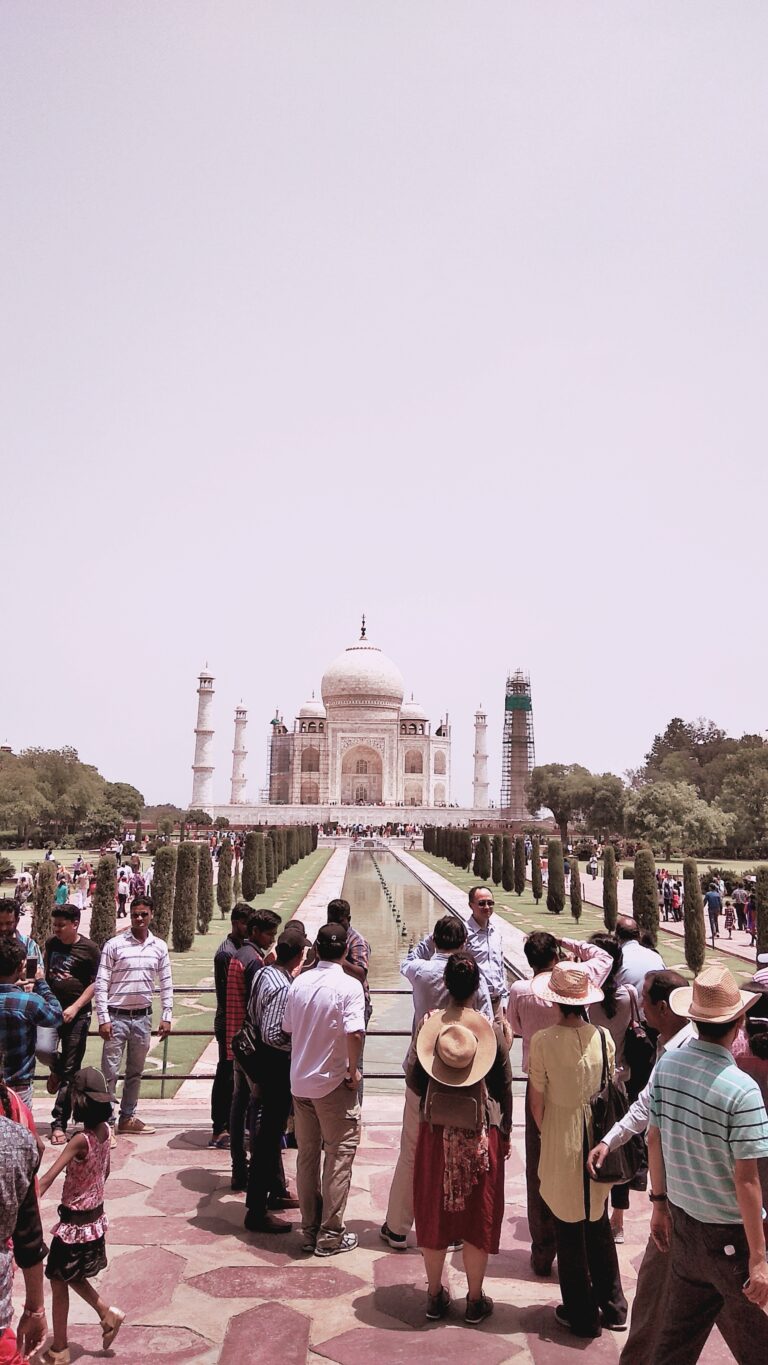
After passing security, you’ll walk towards the great red sandstone gateway, the Darwaza-i-Rauza. Stepping through it gives you the famous first view of the Taj Mahal, framed by the arch and reflected in the long water channel of the gardens. It’s a moment most visitors never forget. Take your time here before walking on; the view through the arch, with the gardens and water channel leading your eye towards the mausoleum, is exactly what the Mughal architects intended you to see first.
From the gateway, paths lead through the formal Mughal garden, divided into four parts by water channels, to the raised marble platform on which the mausoleum stands. You’ll need to put on the shoe covers provided, or remove your shoes, before stepping onto the platform.
Allow two to three hours to explore properly, and don’t forget to look closely at the details: the inlaid semi-precious stones, the carved marble flowers and the Quranic calligraphy around the arches, which was designed to appear the same size from the ground even as it rises higher. Two to three hours gives you time to take in the view from the gateway, walk through the gardens, visit the mausoleum, see the mosque and guest house on either side, and walk to the back of the platform for views over the Yamuna river towards Agra Fort.
What to wear
There’s no strict dress code for visiting the Taj Mahal, but because the complex includes a working mosque and is a place of great significance, modest clothing is appreciated. Loose clothes that cover your shoulders and knees are comfortable in the heat and respectful. You’ll be walking on marble in shoe covers or bare feet, so wear shoes that are easy to slip on and off. In winter, bring a warm layer for the early morning, as it can be surprisingly cold before sunrise; by mid-morning you’ll probably want to take it off. My India packing list has more detail by season.
Visiting with children, older parents or limited mobility
The Taj Mahal is manageable for most visitors, but there’s more walking than people expect. From the parking area to the gate, through security, across the gardens and up to the marble platform is a fair distance, and there are steps up to the platform. Battery-powered vehicles usually run from the parking areas to the gates, and wheelchairs are generally available on request. Visiting at sunrise avoids the worst of the heat and the crowds, which helps a great deal with children and older travellers. I’ve written more about this in India with kids and travelling India with elderly parents.
Photography tips
The classic photograph is taken from the central platform in front of the gateway, looking down the water channel towards the Taj. At sunrise this spot fills quickly, so head there first if photographs matter to you. The gardens, the side buildings and the riverside terrace offer quieter angles. Remember that photography is not allowed inside the tomb chamber, and tripods are not permitted.
The best time of year to visit
The Taj Mahal is open all year, but the experience varies with the season. From October to March, the weather is generally pleasant, with warm days and cool mornings, which makes this the most popular time to visit. February and March are especially lovely, with clear skies and comfortable temperatures. From April to June, Agra is extremely hot, often over 40°C, and a sunrise visit is the only comfortable option. During the monsoon, from July to September, rain is likely and the gardens are green, with fewer visitors. Indian holidays and long weekends bring very large crowds whatever the season. For more on the seasons in north India, see the best time to visit Delhi.
Fog in winter
From mid-December to around the end of January, thick fog sometimes covers Agra in the early morning, and on some days the Taj Mahal is barely visible at sunrise. The fog usually lifts by mid-morning. If your sunrise visit is foggy, don’t be discouraged. Stay a little longer, explore the gardens, and you’ll often see the monument emerge as the fog clears. If your schedule is flexible in winter, a mid-morning visit can sometimes be a better choice.
Full moon night viewing
The Taj Mahal is also open for night viewing on the night of the full moon and on the two nights before and after it, except on Fridays and during the month of Ramadan. Tickets are sold separately, in advance, in limited numbers, and visits take place in small groups for a short time. You view the Taj from a distance, from the platform near the gateway, rather than walking up to the mausoleum. It’s a beautiful experience, but it doesn’t replace a daytime visit. Rules and booking arrangements change, so check the official sources well in advance.
Common mistakes to avoid
Planning an Agra day on a Friday. It’s the most common mistake I see. The Taj Mahal is closed to visitors every Friday.
Arriving late. By mid-morning, the queues and crowds are much larger. Aim to be at the gate before opening time.
Bringing too much. Large bags, food and tripods aren’t allowed, and depositing them takes time. Travel light.
Buying tickets from strangers. Only buy tickets from the official counters or the official online portal.
Rushing. The Taj Mahal deserves time. Allow two to three hours so you can walk the gardens, see the mausoleum and simply sit and look.
Where to stay near the Taj Mahal
If you want to see the Taj at sunrise, staying close to the monument makes a huge difference. The area around the east gate has a good range of hotels, from mid-range to luxury, and is generally calmer than the lanes near the west and south gates. Some hotels have rooftop restaurants or rooms with views of the Taj, which are a lovely bonus. Book early in peak season, especially for weekends and holidays.
Getting to the Taj Mahal for sunrise
The easiest way to see the Taj Mahal at sunrise is to stay overnight in Agra, ideally in a hotel near the east or west gate. If you’re travelling from Delhi on the same day, you’ll need a very early start, as the drive takes three and a half to four hours. I’ve compared the travel options in Delhi to Agra by train or car, and how Agra fits into a wider trip in how many days the Golden Triangle needs.
What else to see in Agra
After the Taj Mahal, many visitors continue to Agra Fort, the great red sandstone fortress of the Mughal emperors, where Shah Jahan spent his final years. Itmad-ud-Daulah’s Tomb, often called the Baby Taj, is a smaller and quieter tomb with exquisite inlay work. In the evening, Mehtab Bagh, a garden on the far bank of the river, offers a lovely view of the Taj Mahal at sunset. Fatehpur Sikri, the abandoned Mughal capital about 40 kilometres away, is also worth a visit if you have time.
Guides at the Taj Mahal
You’ll be approached by people offering to guide you around the Taj Mahal. If you hire a guide at the gate, make sure they carry a valid government-issued guide licence, agree the price and duration clearly before you start, and confirm that the visit is limited to the Taj Mahal itself unless you want to go elsewhere. I’ve described common tricks in Delhi tourist scams, and some of them also appear in Agra.
If you’d like a guide with you for your whole trip, including Agra, I work as a private tour guide across India. And if you’d like help planning your route, my India trip planning calls are designed for that.
Taj Mahal at sunrise: questions people ask me
What time does the Taj Mahal open?
It opens 30 minutes before sunrise and closes 30 minutes before sunset, every day except Friday.
How much is the Taj Mahal ticket for foreigners?
The official Agra district website lists ₹1,100 for the complex, plus ₹200 to enter the main mausoleum. Prices can change, so check the official portal before you go.
Is the Taj Mahal closed on Fridays?
Yes. It’s closed to visitors every Friday.
Which gate is best for sunrise at the Taj Mahal?
The east gate is often a little quieter at sunrise. The south gate is generally used as an exit.
Should I buy Taj Mahal tickets online?
Yes. It saves time in the morning and is usually slightly cheaper. Use the official portal only.
Is sunrise at the Taj Mahal worth it?
Yes. The light is softer, the crowds are smaller and the temperature is more comfortable.
Planning your Taj Mahal visit? Message me on WhatsApp and I’ll be happy to help.

About the author
Ashish
Ashish is a Delhi-based tour guide, certified by India’s Ministry of Tourism under the Incredible India Tourist Guide (IITG) programme. He lives in Delhi, guides visitors from abroad in person, and writes practical, honest advice to help first-time travellers plan their trip to India.
One Comment